What's New in HyperIndex V3
15 full months have passed since the official HyperIndex v2.0.0. Since then, we have shipped 32 minor releases and multiple patches with zero breaking changes to the documented API. We also received PRs from 6 external contributors, grew from 1 GitHub star to over 470, and saw many big projects rely on HyperIndex.
HyperIndex V3 focuses on modernizing the codebase and laying the foundation for many more months of development. This page describes everything that's new. To upgrade an existing project from V2, follow the Migrate to V3 guide.
New Features
Unified Handlers API
In V3 all handler registrations now happen through a single indexer value. Contract-specific exports (ERC20.Transfer.handler, UniV3.PoolFactory.contractRegister, etc.) have been removed in favor of indexer.onEvent, indexer.contractRegister, and indexer.onBlock.
Event handlers with indexer.onEvent:
import { indexer } from "envio";

indexer.onEvent(
  {
    contract: "ERC20",
    event: "Transfer",
    wildcard: true,
    where: ({ chain }) => ({
      params: [
        { from: chain.Safe.addresses },
        { to: chain.Safe.addresses },
      ],
    }),
  },
  async ({ event, context }) => {
    // Handler logic
  },
);
Dynamic contracts with indexer.contractRegister:
import { indexer } from "envio";

indexer.contractRegister(
  {
    contract: "UniV3",
    event: "PoolFactory",
  },
  async ({ event, context }) => {
    context.chain.Pool.add(event.params.poolAddress);
  },
);
Block handlers with indexer.onBlock consolidate across chains in a single call:
import { indexer } from "envio";

indexer.onBlock(
  { name: "EveryBlock" },
  async ({ block, context }) => {
    // Handler logic
  },
);
For chain-specific or interval-based block handlers, use the where callback:
indexer.onBlock(
  {
    name: "Ranges",
    where: ({ chain }) => {
      if (chain.id !== 1) return false;
      return {
        block: {
          number: {
            _gte: 20_000_000,
            _lte: 22_000_000,
            _every: 100,
          },
        },
      };
    },
  },
  async ({ block, context }) => {
    // Handler logic
  },
);
Per-Event Start Block
Handlers can specify custom start blocks per chain via where.block.number._gte, overriding contract and chain configuration:
indexer.onEvent(
  {
    contract: "UniV4",
    event: "Pool",
    where: ({ chain }) => {
      let startBlock: number;
      switch (chain.id) {
        case 1:
          startBlock = 18_000_000;
          break;
        case 8453:
          startBlock = 2_000_000;
          break;
        default: {
          const _exhaustive: never = chain.id;
          return false;
        }
      }
      return {
        block: { number: { _gte: startBlock } },
      };
    },
  },
  async ({ event, context }) => {
    // Handler logic
  },
);
CommonJS → ESM
We migrated HyperIndex from CommonJS-only to ESM-only. This enables:
- Using the latest versions of libraries that have long since abandoned CommonJS support
- Top-level await in handler files
Top-Level Await
Thanks to the migration to ESM, you can now use await directly in handler and other files:
import { indexer } from "envio";

const ZERO_ADDRESS = "0x0000000000000000000000000000000000000000";

// Load data before registering handlers
const addressesFromServer = await loadWhitelistedAddresses();

indexer.onEvent(
  {
    contract: "ERC20",
    event: "Transfer",
    wildcard: true,
    where: {
      params: [
        { from: ZERO_ADDRESS, to: addressesFromServer },
        { from: addressesFromServer, to: ZERO_ADDRESS },
      ],
    },
  },
  async ({ event, context }) => {
    // ... your handler logic
  },
);
3x Historical Backfill Performance
Achieved by adding chunking logic to request events across multiple ranges at once. This also fixed overfetching for contracts with a much later start_block in the config, as well as speeding up dynamic contract registration. If you had data fetching as a bottleneck, 25k events per second is now a standard.
Automatic Handler Registration (src/handlers)
We introduced automatic registration of handler files located in src/handlers.
Previously, you needed to specify an explicit path to a handler file for every contract in config.yaml. Now you can remove all of the paths from config.yaml and simply move the files to src/handlers. You can name the files however you want, but we suggest using contract names and having a file per contract.
If you don't like src/handlers, use the handlers option in config.yaml to customize it.
The explicit handler field in config.yaml still works, so you don't need to change anything immediately.
RPC for Realtime Indexing
Built by an external contributor @cairoeth to allow specifying realtime mode for an RPC data source to embrace low-latency head tracking:
rpc:
  - url: https://eth-mainnet.your-rpc-provider.com
    for: realtime
In this case, the RPC won't be used for historical sync but will be used as the primary source once the indexer enters realtime mode.
Chain State on Context
The Handler Context object provides chain state via the chain property:
import { indexer } from "envio";

indexer.onEvent(
  { contract: "ERC20", event: "Approval" },
  async ({ context }) => {
    console.log(context.chain.id); // 1 - The chain id of the event
    console.log(context.chain.isRealtime); // true - Whether the indexer entered realtime mode
  },
);
Indexer State & Config
As a replacement for the deprecated and removed getGeneratedByChainId, we introduce the indexer value. It provides nicely typed chains and contract data from your config, as well as the current indexing state, such as isRealtime and addresses. Use indexer either at the top level of the file or directly from handlers. It returns the latest indexer state.
With this change, we also introduce new official types: Indexer, EvmChainId, FuelChainId, and SvmChainId.
import { indexer } from "envio";

indexer.name; // "uniswap-v4-indexer"
indexer.description; // "Uniswap v4 indexer"
indexer.chainIds; // [1, 42161, 10, 8453, 137, 56]
indexer.chains[1].id; // 1
indexer.chains[1].startBlock; // 0
indexer.chains[1].endBlock; // undefined
indexer.chains[1].isRealtime; // false
indexer.chains[1].PoolManager.name; // "PoolManager"
indexer.chains[1].PoolManager.abi; // unknown[]
indexer.chains[1].PoolManager.addresses; // ["0x000000000004444c5dc75cB358380D2e3dE08A90"]
On indexer restart, reading indexer at the top level of a handler file returns values restored from the database — including dynamically registered contract addresses — rather than only what's declared in config.yaml:
import { indexer } from "envio";

// Includes initial + dynamically registered addresses persisted in the DB
console.log(indexer.chains.eth.Pool.addresses);
Conditional Event Handlers
Now it's possible to return a boolean value from the where function to disable or enable the handler conditionally.
import { indexer } from "envio";

indexer.onEvent(
  {
    contract: "ERC20",
    event: "Transfer",
    wildcard: true,
    where: ({ chain }) => {
      // Skip all ERC20 on Polygon
      if (chain.id === 137) {
        return false;
      }

      // Track all ERC20 on Ethereum Mainnet
      if (chain.id === 1) {
        return true;
      }

      // Track only whitelisted addresses on other chains
      return {
        params: [
          { from: ZERO_ADDRESS, to: WHITELISTED_ADDRESSES[chain.id] },
          { from: WHITELISTED_ADDRESSES[chain.id], to: ZERO_ADDRESS },
        ],
      };
    },
  },
  async ({ event, context }) => {
    // ... your handler logic
  },
);
Automatic Contract Configuration
Started automatically configuring all globally defined contracts. This fixes an issue where addContract crashed because the contract was defined globally but not linked for a specific chain. Now it's done automatically:
contracts:
  - name: UniswapV3Factory
    events: # ...
  - name: UniswapV3Pool
    events: # ...
chains:
  - id: 1
    start_block: 0
    contracts:
      - name: UniswapV3Factory
        address: "0x1F98431c8aD98523631AE4a59f267346ea31F984"
      # UniswapV3Pool no longer needed here - auto-configured from global contracts
  - id: 10
    start_block: 0
    contracts:
      - name: UniswapV3Factory
        address: "0x1F98431c8aD98523631AE4a59f267346ea31F984"
      # UniswapV3Pool no longer needed here - auto-configured from global contracts
ClickHouse Storage (Experimental)
HyperIndex can now run with multiple storage backends at the same time. Postgres remains the primary database, and entities can additionally be written to a ClickHouse database that is restart- and reorg-resistant. Prometheus metrics carry a storage-name label so you can distinguish backends.
Enable both backends in config.yaml:
storage:
  postgres: true
  clickhouse: true
envio dev automatically spins up a ClickHouse Docker container for local development. For envio start, provide your own connection via the environment variables ENVIO_CLICKHOUSE_HOST, ENVIO_CLICKHOUSE_DATABASE, ENVIO_CLICKHOUSE_USERNAME, and ENVIO_CLICKHOUSE_PASSWORD. Currently supported only on Dedicated Plan.
Do not run multiple indexers writing to the same ClickHouse database at the same time.
HyperSync Source Improvements
Multiple updates on the HyperSync side to achieve smaller latency and less traffic:
- Server-Sent Events instead of polling to get updates about new blocks
- CapnProto instead of JSON for query serialization
- Cache for queries with repetitive filters - huge egress saving when indexing thousands of addresses
- Improved connection establishment behind a proxy
- Configurable log level support via
ENVIO_HYPERSYNC_LOG_LEVELenvironment variable - Automatic rate-limiting handling on the client side
- Better reconnection logic, logging, and fallbacks for HyperSync SSE and RPC WebSocket height streaming for more stable indexing at the chain head
Fuel Block Handler Support
Block handlers are now supported for Fuel indexing.
Solana Support (Experimental)
HyperIndex now supports Solana with RPC as a source. This feature is experimental and may undergo minor breaking changes. Solana exposes its block-stream handler as indexer.onSlot (rather than onBlock) to match Solana's slot-based model.
To initialize a Solana project:
pnpx envio@3.0.0-rc.0 init svm
See the Solana documentation for more details.
pnpx envio@3.0.0-rc.0 init Improvements
- Removed language selection to prefer TypeScript by default
- Cleaned up templates to follow the latest good practices
- Added new templates to highlight HyperIndex features:
Feature: Factory Contract,Feature: External Calls - Pre-configured GitHub Actions workflow for running tests and initialized git repository
- Generated projects include Cursor/Claude skills to support agent-driven development
Block Handler Only Indexers
Now it's possible to create indexers with only block handlers. Previously, it was required to have at least one event handler for it to work. The contracts field became optional in config.yaml.
Flexible Entity Fields
We no longer have restrictions on entity field names, such as type and others. Shape your entities any way you want. There are also improvements in generating database columns in the same order as they are defined in the schema.graphql.
Unordered Multichain Mode Only
Unordered multichain mode is now the only mode in V3 — events from different chains are processed in parallel without strict cross-chain ordering, which provides better performance for most use cases. The V2 unordered_multichain_mode option and the multichain: ordered opt-in have been removed.
Preload Optimization by Default
Preload optimization is now enabled by default, replacing the previous loaders and preload_handlers options. This improves historical sync performance automatically.
TUI Improvements
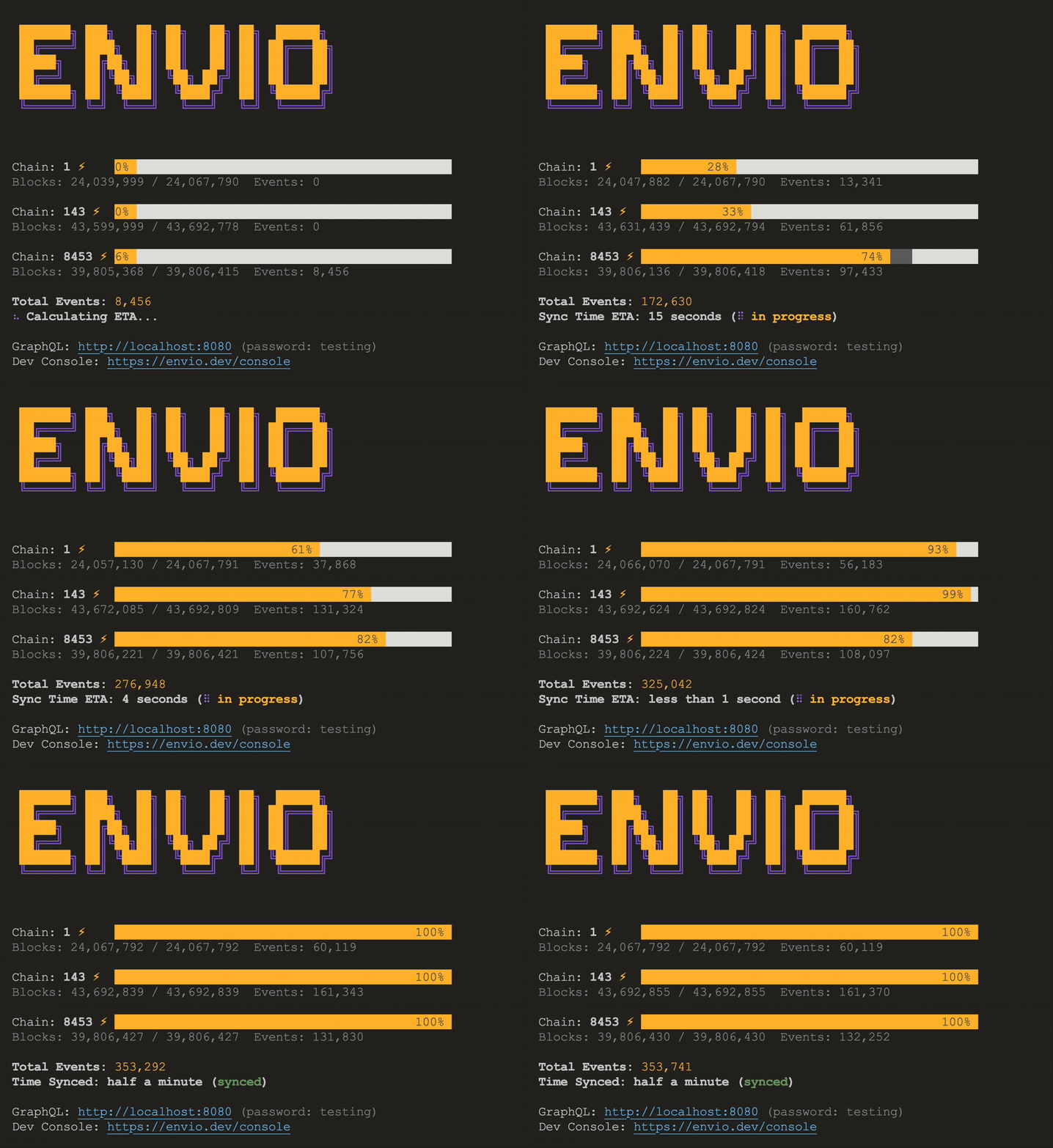
We gave our TUI some love, making it look more beautiful and compact. It also consumes fewer resources, shares a link to the Hasura playground, and dynamically adjusts to the terminal width.
The TUI is now auto-disabled in CI environments and when running under AI agents, so logs stay clean without manual configuration. The legacy TUI_OFF=true environment variable was renamed to ENVIO_TUI=false.
New Testing Framework
HyperIndex ships a purpose-built testing framework powered by createTestIndexer(). Write tests against the same indexer that runs in production — no database, no Docker, no manual mock wiring.
The framework integrates with Vitest, replacing the previous mocha/chai setup with a single package that doesn't require configuration by default and includes snapshot testing out-of-the-box. It also provides typed test assertions and utilities to read/write entities in-between processing runs.
Three ways to feed events
1. Auto-exit — processes the first block with matching events, then exits. Each subsequent call continues where the last one stopped. Zero config needed.
import { describe, it } from "vitest";
import { createTestIndexer } from "envio";

describe("ERC20 indexer", () => {
  it("processes the first block with events", async (t) => {
    const indexer = createTestIndexer();

    const result = await indexer.process({ chains: { 1: {} } });

    // Auto-filled by Vitest on first run — just review and commit
    t.expect(result).toMatchInlineSnapshot(`
      {
        "changes": [
          {
            "Transfer": {
              "sets": [
                {
                  "blockNumber": 10861674,
                  "from": "0x0000000000000000000000000000000000000000",
                  "id": "1-10861674-23",
                  "to": "0x41653c7d61609D856f29355E404F310Ec4142Cfb",
                  "transactionHash": "0x4b37d2f343608457ca...",
                  "value": 1000000000000000000000000000n,
                },
              ],
            },
            "block": 10861674,
            "chainId": 1,
            "eventsProcessed": 1,
          },
        ],
      }
    `);
  });
});
2. Explicit block range — pin to specific blocks for deterministic CI snapshots.
const result = await indexer.process({
  chains: {
    1: {
      startBlock: 10_861_674,
      endBlock: 10_861_674,
    },
  },
});
3. Simulate — feed typed synthetic events for pure unit tests. No network, no block ranges.
await indexer.process({
  chains: {
    137: {
      simulate: [
        {
          contract: "Greeter",
          event: "NewGreeting",
          params: { greeting: "Hello", user: "0x123..." },
        },
      ],
    },
  },
});
Key capabilities
- Snapshot-driven assertions —
result.changescaptures every entity set/delete per block. Pair withtoMatchInlineSnapshotfor auto-generated, reviewable snapshots. - Direct entity access —
indexer.Entity.get(),.getOrThrow(),.getAll(), and.set()for reading and presetting state. - Real pipeline, real confidence — tests exercise the full indexer pipeline including dynamic contract registration, multi-chain support, and handler context.
- Parallel test execution via worker thread isolation.
The test indexer also exposes chain information:
const indexer = createTestIndexer();
indexer.chainIds; // [1, 42161]
indexer.chains[1].id; // 1
indexer.chains[1].startBlock; // 0
indexer.chains[1].ERC20.addresses; // ["0x..."]

// Read/write entities between processing runs
await indexer.Account.set({ id: "0x123...", balance: 100n });
const account = await indexer.Account.get("0x123...");
See the Testing documentation for more details.
Podman Support
Beyond Docker, HyperIndex now supports Podman for local development environments. This provides an alternative container runtime for developers who prefer Podman or have it available in their environment.
Nested Tuples for Contract Import
The envio init command now supports contracts with nested tuples in event signatures, which was previously a limitation when importing contracts.
PostgreSQL Update for Local Docker Compose
The local development Docker Compose setup now uses PostgreSQL 18.1 (upgraded from 17.5).
contractName and eventName on Event
Events now include contractName and eventName fields, making it easier to identify which contract and event you're working with in handlers:
import { indexer } from "envio";

indexer.onEvent(
  { contract: "ERC20", event: "Transfer" },
  async ({ event }) => {
    console.log(event.contractName); // "ERC20"
    console.log(event.eventName);    // "Transfer"
  },
);
New Official Exported Types
Generated code now exports official generic types for entities, enums, and events. These replace the previous contract-specific type exports:
import type {
  MyEntity,        // Still exported but Entity<"MyEntity"> is preferred
  Entity,          // Generic entity type — use as Entity<"MyEntity">
  Enum,            // Generic enum type — use as Enum<"MyEnum"> (replaces direct MyEnum export)
  EvmEvent,        // Generic event type — use as EvmEvent<"ERC20", "Transfer">
                   // Access specific fields: EvmEvent<"ERC20", "Transfer">["block"]
} from "envio";
Support for DESC Indices
A nice way to improve your query performance as well:
type PoolDayData
  @index(fields: ["poolId", ["date", "DESC"]]) {
  id: ID!
  poolId: String!
  date: Timestamp!
}
RPC Source Improvements
Added polling_interval option for RPC source configuration. Also added missing support for receipt-only fields (gasUsed, cumulativeGasUsed, effectiveGasPrice) that are not available via eth_getTransactionByHash. HyperIndex will additionally perform the eth_getTransactionReceipt request when one of the fields is added in field_selection.
WebSocket Support (Experimental)
Experimental WebSocket support for RPC source to improve head latency. Please create a GitHub issue if you come across any problems.
chains:
  - id: 1
    rpc:
      url: ${ENVIO_RPC_ENDPOINT}
      ws: ${ENVIO_WS_ENDPOINT}
      for: realtime
Prometheus Metrics for Data Providers
Added a Prometheus metric to track requests to data providers, providing better observability into your indexer's data fetching patterns.
GraphQL-Style getWhere API
The getWhere query API has been redesigned using GraphQL-style syntax:
// Before
const transfers = await context.Transfer.getWhere.from.eq("0x123...");

// After
const transfers = await context.Transfer.getWhere({ from: { _eq: "0x123..." } });
Additionally, three new filter operators are available following Hasura-style conventions:
context.Entity.getWhere({ amount: { _gte: 100n } })
context.Entity.getWhere({ amount: { _lte: 500n } })
context.Entity.getWhere({ status: { _in: ["active", "pending"] } })
Direct RPC Client
Replaced Ethers.js with a direct RPC client implementation, reducing dependencies and improving performance.
Block Lag Configuration
A per-chain block_lag option to index behind the chain head by a specified number of blocks. Replaces the global ENVIO_INDEXING_BLOCK_LAG environment variable. Defaults to 0. This is for advanced use cases — only use it if you know what you're doing.
chains:
  - id: 1
    block_lag: 5
Official /metrics Endpoint
Prometheus metrics are now official. We cleaned up metric names, switched time units to seconds instead of milliseconds, and followed Prometheus naming conventions more closely. Metrics also cover data points previously available only via the --bench feature. A separate /metrics/runtime endpoint with a dedicated Prometheus registry is available for runtime metrics, isolated from the default /metrics endpoint.
Starting from the v3.0.0 release, Prometheus metrics will follow semver and be documented.
Breaking changes:
- Cleaned up metric names and switched time units from milliseconds to seconds
- Removed
--benchsupport — use the/metricsendpoint instead
Use the new envio metrics CLI command to fetch the Prometheus metrics of a locally running indexer without curling the endpoint manually.
Continue on Config Change
HyperIndex can now keep indexing through some config.yaml changes — rpc configuration is the first to land — instead of erroring out on every restart. Where a change is incompatible, the CLI prints exactly which fields were touched and offers two clear options (revert, or envio dev -r to wipe and re-index). More flexibility will be unlocked over time; open a GitHub issue if you need a specific field supported.
Double Handler Registration
It's now possible to register multiple handlers for the same event with similar filters:
import { indexer } from "envio";

indexer.onEvent(
  { contract: "ERC20", event: "Transfer" },
  async ({ event, context }) => {
    // Your logic here
  },
);

indexer.onEvent(
  { contract: "ERC20", event: "Transfer" },
  async ({ event, context }) => {
    // And here
  },
);
Improved Multiple Data-Sources Support
After switching to a fallback source, HyperIndex now attempts to recover to the primary source 60 seconds later. Previously, it would stay on the fallback until the fallback was down or the indexer was restarted. The source selection logic has also been improved for better indexing resilience and stricter enforcement of the realtime mode configuration.
Updated Dev Docker Flow
envio dev no longer uses a generated Docker Compose file and manages containers, network, and volumes directly for greater flexibility. For example, disabling Hasura with ENVIO_HASURA now prevents envio dev from pulling the Hasura image. Use envio dev --restart (or -r) to forcefully clear the database even if there are no config changes detected.
Envio Dev Update
envio dev no longer automatically resets the database on incompatible config or schema changes. Use envio dev -r to explicitly allow this.
Envio Start Update
envio start now has a clear role: to run HyperIndex in the production environment. Use envio dev for local development to enable debugging with Dev Console.
Optimized envio codegen
envio codegen is now near-instant. We no longer run pnpm i for the generated package, and we no longer recompile ReScript every time you change config.yaml or schema.graphql. The output is also a lot quieter.
Smaller envio Package (-88MB)
By eliminating dynamically generated ReScript code, we no longer need to ship or run a ReScript compiler at runtime. The published npm package shrank from 141MB to 53MB.
No Hard pnpm Requirement
Internal use of pnpm is gone. The generated package no longer has its own dependency tree, so HyperIndex works with whichever package manager you prefer.
Bun Support
Run HyperIndex on Bun:
bun --bun envio dev
Choose Your Package Manager on envio init
envio init now accepts --package-manager=pnpm|npm|bun|yarn so you can scaffold projects without committing to pnpm.
Better Tuples Developer Experience
Solidity struct components used to be generated as positional tuples in handler params, which made handler code awkward. They are now generated as objects with named fields:
struct CreateEventCommon {
  address funder;
  address sender;
  address recipient;
  Lockup.CreateAmounts amounts;
  IERC20 token;
  bool cancelable;
  bool transferable;
  Lockup.Timestamps timestamps;
  string shape;
  address broker;
}

event CreateLockupTranchedStream(
  uint256 indexed streamId,
  Lockup.CreateEventCommon commonParams,
  LockupTranched.Tranche[] tranches
);
// Before
event.params.commonParams[5];
event.params.commonParams[3][0];

// After
event.params.commonParams.cancelable;
event.params.commonParams.amounts.deposit;
Improved Multichain Backfill
For large multichain indexers, HyperIndex now throttles chains that have already reached the head so they don't compete for resources while the rest finish backfilling. Once every chain has caught up, throttling is lifted and all chains continue indexing equally.
Toolchain Upgrades
- ReScript upgraded from v11 to v12 (internally and in
envio inittemplates) - TypeScript upgraded from v5 to v6 (internally and in
envio inittemplates)
Fixes
- Fixed an issue where the indexer stops progressing without any error (PostgreSQL client update)
- Fixed checksum for addresses returned by RPC in lowercase
- Fixed incorrect validation of transactions
tofield returned by RPC - Fixed OOM error on RPC request crashing loop
- Fixed an edge case where a multichain indexer could freeze during a rollback on reorg (also backported to v2.32.10)
- Fixed external Postgres database support via
ENVIO_PG_HOST - Fixed
S.nullableschema type to beT | nullinstead ofT | undefined
Release Notes
For detailed release notes, see:
- v3.0.0-rc.0
- v3.0.0-alpha.24
- v3.0.0-alpha.23
- v3.0.0-alpha.22
- v3.0.0-alpha.21
- v3.0.0-alpha.20
- v3.0.0-alpha.19
- v3.0.0-alpha.18
- v3.0.0-alpha.17
- v3.0.0-alpha.16
- v3.0.0-alpha.15
- v3.0.0-alpha.14
- v3.0.0-alpha.13
- v3.0.0-alpha.12
- v3.0.0-alpha.11
- v3.0.0-alpha.10
- v3.0.0-alpha.9
- v3.0.0-alpha.8
- v3.0.0-alpha.7
- v3.0.0-alpha.6
- v3.0.0-alpha.5
- v3.0.0-alpha.4
- v3.0.0-alpha.3
- v3.0.0-alpha.2
- v3.0.0-alpha.1
- v3.0.0-alpha.0